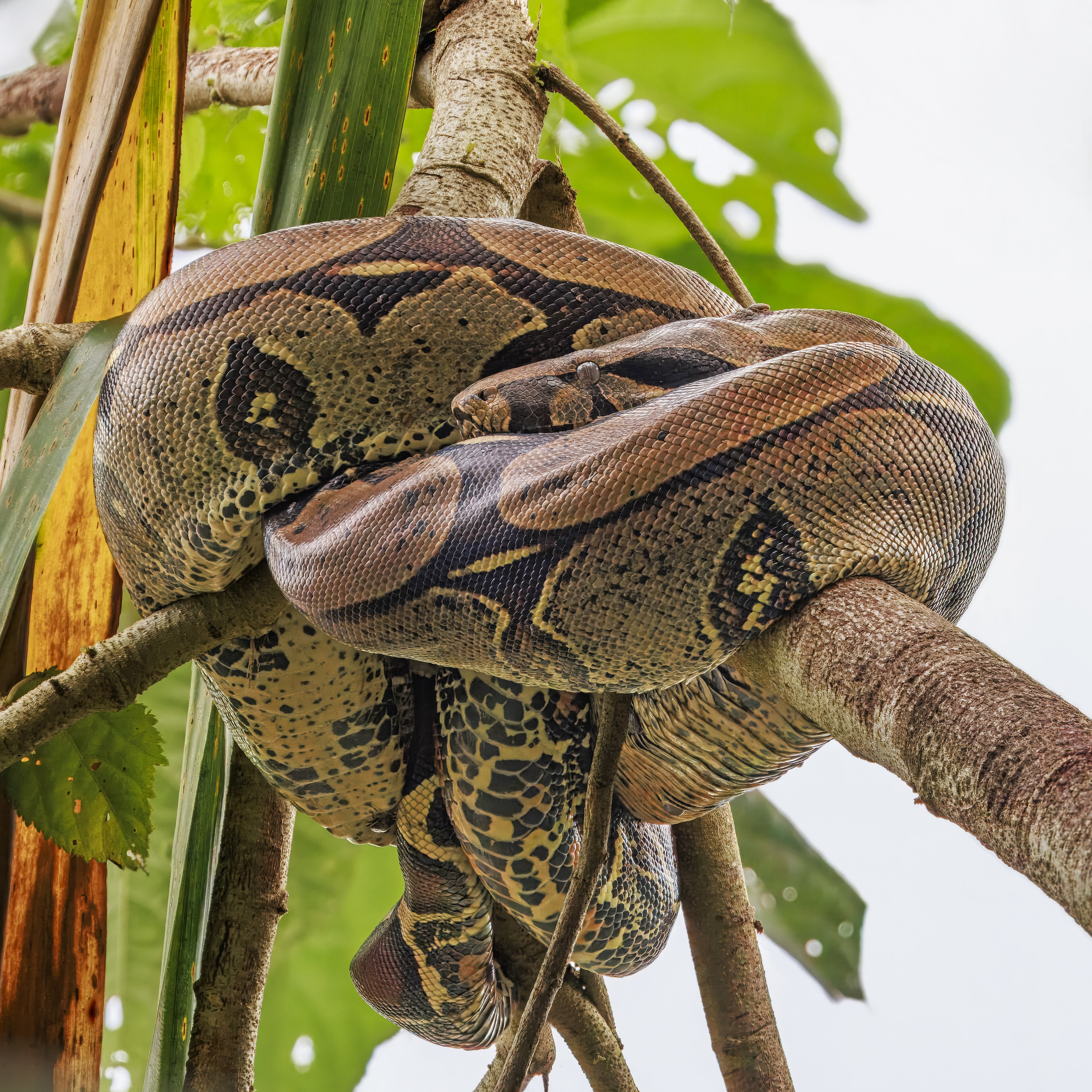
Anery Anerythristic The Anerythristic (Anery) locus is a recessive trait that eliminates erythrophore (red pigment cell) function, removing red and orange coloration from the animal. Homozygous Anerythristic boa constrictors display a striking black, white, and gray pattern with the characteristic boa saddle pattern retained but rendered in grayscale. Some yellow pigment often remains, particularly in the tail region, as a small amount of xanthophore (yellow pigment) activity persists in most animals. The yellow tail is a commonly noted feature of Anerythristic boas and is considered normal for the morph. The overall appearance is dramatic — the typical warm brown and orange tones of a normal boa are replaced by crisp black and silver/white, making Anerythristic a visually striking and commercially valuable morph. Anerythristic is a foundational building block for several major combo morphs including Ghost (Anery + Hypo), Snow (Kahl Albino + Anery), and Moonglow (Kahl Albino + Anery + Hypo). Heterozygous carriers (hets) appear phenotypically normal with no visual indicator of het status. Recessive Line-specific ›
Arabesque Arabesque The Arabesque locus is a recessive trait that produces a distinctive modified patterning in Boa constrictor. Homozygous Arabesque animals display an intricate, modified saddle pattern often described as "arabesque" or interlocking ring-like — the normal solid saddles are replaced by open, irregular, swirling or ring-like markings that create a distinctive ornamental appearance, similar in concept to arabesque decorative art (hence the name). The pattern modification can range from moderately to dramatically altered depending on the individual and breeding line. Arabesque is a relatively specialized morph in the boa hobby, maintained by dedicated breeders. It combines well with color morphs (particularly Albino) to produce striking patterned animals. Heterozygous carriers (het Arabesque) appear phenotypically normal. Recessive Line-specific ›
Blood Blood The Blood locus is an incomplete dominant trait in Boa constrictor that dramatically intensifies red and orange pigmentation while simultaneously reducing the dorsal pattern. Three phenotypes exist based on zygosity. Wild type (non-Blood) displays the normal boa pattern with standard coloration. Heterozygous Blood animals (the "Blood" morph) show intensified red and orange coloration with reduced pattern contrast — the saddle pattern becomes less defined against the background, and the overall appearance is warmer and more suffused with red/orange than a normal boa. Homozygous Super Blood animals take this much further: extremely intensified red/orange coloration that can appear almost solid red in some individuals, with the saddle pattern heavily reduced or nearly absent. Super Blood boas are among the most intensely colored boa constrictors in the hobby. Blood is an important building block for combo morphs: Blood x Jungle, Blood x Anery, and Blood x Hypo each produce striking animals with their own established names. Incomplete dom. Common ›
CAAlb Central American Albino The Central American Albino locus is the third confirmed independent albino locus in Boa constrictor. Homozygous animals are amelanistic with orange/yellow-on-white coloration and pink to red eyes, visually similar to the Kahl and Sharp strains. Central American Albino is confirmed non-allelic with both Kahl and Sharp through complementation testing: crossing Central American x Kahl or Central American x Sharp produces phenotypically normal double-het offspring in all cases. This mirrors the exact pattern of the three independent albino strains in leopard geckos (Tremper, Bell, Rainwater), confirming that multiple independent mutations can produce the same phenotypic outcome at different steps in the melanin synthesis pathway. Central American Albino is the least common of the three boa albino strains in the commercial hobby and is primarily maintained by specialist breeders tracking strain identity carefully. Line-specific ›
Hypo Hypomelanistic The Hypomelanistic (Hypo) locus is a recessive trait that reduces melanin production in Boa constrictor, producing an animal with lighter, more washed-out coloration compared to wild type. Homozygous Hypo animals retain their full color palette — including the orange and red pigments — but with reduced dark brown and black melanin. The result is a lighter, "cleaner" appearance: the saddle pattern is present but the dark portions are lightened to brown or tan rather than dark brown to black. The saddle edges may appear softer and the contrast between dark and light areas is reduced. The background color is typically lighter and cleaner. Hypo can be recognized as a melanin-reduction morph (compared to Albino, which eliminates melanin entirely). Hypo is one of the most commercially important recessive morphs in the boa hobby because of its powerful enhancement of color in combinations — particularly Sunglow (Kahl Albino + Hypo), which is one of the most popular boa morphs ever produced. Heterozygous carriers (het Hypo) appear phenotypically normal with no visual indicator of het status. Recessive Line-specific ›
IMG IMG (Increasing Melanin Gene) The IMG (Increasing Melanin Gene) locus is an incomplete dominant trait that progressively increases melanin deposition throughout the animal's life, causing the snake to darken with age. Unlike most morph traits that are fixed at hatching, IMG produces a dynamic phenotype that continues to change over months and years. Three phenotypes exist based on zygosity. Heterozygous IMG (single copy) animals hatch with relatively normal to slightly enhanced dark coloration, but progressively darken with each shed cycle as they age — the dark saddle pattern expands and the light background between saddles becomes increasingly invaded by melanin. Adult het IMG animals may appear significantly darker than non-IMG animals of the same species. Homozygous Super IMG animals show this darkening effect dramatically accelerated and intensified — they may appear nearly solid dark/black as adults, with the pattern almost completely obscured by melanin deposition. IMG is notable for being one of the only boa morphs with a predictably progressive phenotype. It originated from Boa constrictor constrictor (true red-tail boa) lines from South America and may express somewhat differently in BCI vs. BCC genetic backgrounds. Incomplete dom. Common ›
Jungle Jungle The Jungle locus is an incomplete dominant trait that produces aberrant (irregular, distorted) patterning in Boa constrictor. Three phenotypes exist based on zygosity. Wild type (non-Jungle) has the normal, bilaterally symmetrical boa saddle pattern. Heterozygous Jungle animals display aberrant patterning: the normally regular saddle pattern becomes irregular, with misaligned, fused, split, or distorted saddles. The degree of aberrancy varies between individuals — some Jungle boas are mildly aberrant while others have dramatically broken or "busy" patterns. Homozygous Super Jungle animals show even more extreme pattern aberrancy, often approaching a nearly patternless or heavily fragmented appearance. Jungle is one of the most widely recognized and popular pattern morphs in boa constrictors and is an important component of several combo morphs. Because Jungle is an aberrant morph, no two Jungle boas are patterned identically. Incomplete dom. Common ›
KahlAlb Kahl Albino The Kahl Albino locus is one of three confirmed independent albino loci in Boa constrictor, each proven non-allelic through complementation testing. Homozygous Kahl Albino animals are amelanistic: they lack all melanin production, producing a vivid orange and yellow pattern on a white background. The orange and yellow pigments (xanthophores and erythrophores) remain fully intact, resulting in a brilliantly colored animal. Eyes are pink to ruby-red due to visible blood vessels in the absence of melanin. The Kahl Albino is the most common and commercially available of the three boa albino strains and serves as the genetic foundation for widely sought-after combos including Sunglow (Kahl + Hypo) and Snow (Kahl + Anery). When crossed to Sharp Albino or Central American Albino, the result is phenotypically normal double-het offspring, confirming separate loci. Heterozygous carriers (hets) are phenotypically normal and indistinguishable from wild-type animals without parentage records or genetic testing. Line-specific ›
Leopard Leopard The Leopard locus is an incomplete dominant trait that reduces and fragments the dorsal saddle pattern in Boa constrictor. Three phenotypes exist based on zygosity. Wild type (non-Leopard) has the normal connected saddle pattern. Heterozygous Leopard animals display a reduced, fragmented saddle pattern — the large connected saddles of the wild type are broken into smaller, more numerous, rounded spots reminiscent of a leopard's spots, hence the name. The pattern becomes fragmented and the spots are more evenly distributed across the dorsal surface. Homozygous Super Leopard animals show dramatically further-reduced patterning, often approaching a near-patternless or heavily flecked appearance. Leopard is an important pattern morph in the boa hobby and is used in combination morphs. Incomplete dom. Common ›
Motley Motley The Motley locus is a recessive trait in Boa constrictor that produces a modified and connected saddle pattern. Homozygous Motley animals display saddles that are reduced in size, merged laterally into a connected dorsal stripe or chain-link pattern, and show reduced pattern contrast. The effect is a "cleaner" appearance compared to the wild-type saddle pattern — the lateral spots often merge with the dorsal saddles to create a continuous chain of connected markings running the length of the body. In some individuals, the pattern approaches a connected dorsal stripe. Motley also tends to clean up background color and reduce "busy" lateral patterning. The Motley trait in boa constrictors is distinct from the Motley locus in corn snakes (where Motley is allelic with Stripe). In boas, Motley is not known to be allelic with any other locus. Heterozygous carriers (het Motley) appear phenotypically normal. Recessive Line-specific ›
SharpAlb Sharp Albino The Sharp Albino locus is one of three confirmed independent albino loci in Boa constrictor. Like Kahl Albino, homozygous Sharp Albino animals are amelanistic — they lack melanin and display an orange/yellow-on-white pattern with pink to red eyes. While visually similar to Kahl Albino, Sharp Albino animals are produced from a genetically distinct locus confirmed through complementation testing: crossing Sharp x Kahl produces phenotypically normal double-het offspring. Some breeders report subtle visual differences between Sharp and Kahl lines (Sharp animals from certain lineages show a more lavender, pearlescent, or "Sharp trait" undertone in the white areas, though this varies significantly by line and individual). Sharp Albino is less common in the market than Kahl Albino but maintains dedicated breeding programs. The Sharp x Sharp cross produces visual albinos at the expected 25% ratio. Sharp Albino can be combined with Kahl Albino genetics to produce "double het" animals that are normal-appearing, which is an important distinction breeders must track carefully. Line-specific ›
• Anerythristic Visual Anerythristic. Homozygous at Anerythristic locus. Striking black and silver/white pattern with all red and orange pigment removed. Saddle pattern rendered in crisp black against a white/gray background. Yellow tail is common and expected. One of the most popular recessive morphs due to its dramatic grayscale appearance and powerful combo potential. Recessive Common ›